I had this idea from poker:
A rich guy who may or may not be good at poker may 'stake' a good player who is lacking his own money to play with. Usually the arrangement is that the stakee plays with the money and the staker gets 50% of profits (and incurs all the risk). The stakee is incentivized because they can also make money and they are relieved of the mental overhead of worrying about losing all their own money. Win-win!
Could we do the same for education?
Suppose I am wealthy and wanted to invest in a way that directly benefits our future. I could give my money as stake "grants" to students who would otherwise be taking out student loans and, regardless of their prospects after, be forced to pay all those back (and even bankruptcy won't wipe student loans!). Putting the risk onto the student could be a barrier to entry for many (I really don't know these details off-hand, but it feels true) and have a set amount they need to pay back could negate whatever income they start to get. With a grant+comission system, I could take on the risk instead. The student would be free from the pressures of immediate payments and could better find the job/direction/entrepreneurship they really want to do. I just wait until they start making money, and depending on the terms of the grant get some cut. Naturally my return should be higher than for a standard loan, but it could really be a win-win. We both do better if they perform. Because the grant would be incentivized for both the staker and stakee, the stakers could make more money available for high-productivity fields. Conventional loans would still be in place for other fields.
Thursday, February 27, 2014

Civil suits in Europe vs USA
I learned a fun fact recently: in Europe, if the plaintiff in a civil suit loses their case, they are required to pay the defendant's legal fees. In America, there is no such obligation. This leads to an ease of filing frivolous lawsuits in America.
I heard about one such case where someone sued, completely illegitimately, for damages of $1M. They knew they would probably lose in court, but they also projected that the defendant would have to spend over $1M to get that verdict. As such, it's cheaper for the defense to just settle with a no-fault clause or similar. Essentially, lawsuits are an opportunistic business. The case went to trial, but after years and over $1M in fees, it was settled because there was just no end in sight.
In Europe, this scenario would have lead to the complete ruin of the plaintiff. The European model discourages (or even prevents?) frivolous suits because there's an additional consequence of losing. Isn't this a great system?
Turns out it has the same exact problem (or at least I think it does), in reverse: it would significantly discourage 50/50 lawsuits because the plaintiff fears they could be on the hook. It also discourages a small entity from suing a big one because the defense fees for the big guy could completely cripple the smaller. I have no idea if there's more nuance here, but both systems run into opposite ends of the same issue spectrum.
Is there a better way? Could the judge just rule "ok come on, that was a frivolous case" vs "yeah, you had reason to believe you might really win"? Is that too arbitrary? We don't want to put barriers (especially financial ones) in the way of small entities seeking justice, but we also have to rein in frivolity. Where's the line?
I heard about one such case where someone sued, completely illegitimately, for damages of $1M. They knew they would probably lose in court, but they also projected that the defendant would have to spend over $1M to get that verdict. As such, it's cheaper for the defense to just settle with a no-fault clause or similar. Essentially, lawsuits are an opportunistic business. The case went to trial, but after years and over $1M in fees, it was settled because there was just no end in sight.
In Europe, this scenario would have lead to the complete ruin of the plaintiff. The European model discourages (or even prevents?) frivolous suits because there's an additional consequence of losing. Isn't this a great system?
Turns out it has the same exact problem (or at least I think it does), in reverse: it would significantly discourage 50/50 lawsuits because the plaintiff fears they could be on the hook. It also discourages a small entity from suing a big one because the defense fees for the big guy could completely cripple the smaller. I have no idea if there's more nuance here, but both systems run into opposite ends of the same issue spectrum.
Is there a better way? Could the judge just rule "ok come on, that was a frivolous case" vs "yeah, you had reason to believe you might really win"? Is that too arbitrary? We don't want to put barriers (especially financial ones) in the way of small entities seeking justice, but we also have to rein in frivolity. Where's the line?
Friday, December 6, 2013
Politicians' thin skin
Politics, by its very nature, has zero-to-few objectively right answers. Sure I think guns are rampant and abortions are ok, but reasonable people can disagree with me and have valid points. And then we have to come together and someone's perspective has to lose.
As such, politicians are rarely trying to find the "truth" or "correct" outcome. They too have opinions and steadfastly defend those. The key difference here is there's no progress towards an ideal outcome, there's just progress towards convincing others their individual outcome is right. In other words, "I want to win the argument", not "I want to get it right".
In an environment like that, there's little incentive to allow another's perspectives to come in play, and any attempt by another to challenge a fundamentally subjective opinion will trigger reactions of personal attack. And it's fair, an individual's opinion is being attacked, thus it is, to some degree, personal.
And that is why political debates and discussions devolve into shouting matches and name-calling.
As such, politicians are rarely trying to find the "truth" or "correct" outcome. They too have opinions and steadfastly defend those. The key difference here is there's no progress towards an ideal outcome, there's just progress towards convincing others their individual outcome is right. In other words, "I want to win the argument", not "I want to get it right".
In an environment like that, there's little incentive to allow another's perspectives to come in play, and any attempt by another to challenge a fundamentally subjective opinion will trigger reactions of personal attack. And it's fair, an individual's opinion is being attacked, thus it is, to some degree, personal.
And that is why political debates and discussions devolve into shouting matches and name-calling.
Tuesday, December 3, 2013
I hate analogies
"As my mom told me, a cop is like a cheetah in pack of gazelles. It's going to catch the slowest one it can!" ... said someone I knew once, explaining why the last slowest offender will be the one to get the ticket. That makes sense, except for the part where that's totally not what would happen. The analogy breaks down because the cop's motivation is not the same as the cheetahs. However, if someone misses this, they will leverage the analogy to make the wrong conclusion.
Why even have an analogy at all? Analogies are a transformation to a familiar set of concepts that are similar enough to drive home the point. This can be useful for very abstract ideas (electricity, theoretical physics, ... ) but really it's best to just talk about what the topic really is. There's no opportunity for creating a distorted frame of reference, and usually it's not a big deal to just talk about the actual concepts. In fact, if you get an analogy perfectly right, you're really just calling things by different names!
I think people like to spout off analogies to show off how deeply they understand a topic, ironically, each subtly wrong analogy shows their lack of detailed understanding of the original topic.
Why even have an analogy at all? Analogies are a transformation to a familiar set of concepts that are similar enough to drive home the point. This can be useful for very abstract ideas (electricity, theoretical physics, ... ) but really it's best to just talk about what the topic really is. There's no opportunity for creating a distorted frame of reference, and usually it's not a big deal to just talk about the actual concepts. In fact, if you get an analogy perfectly right, you're really just calling things by different names!
I think people like to spout off analogies to show off how deeply they understand a topic, ironically, each subtly wrong analogy shows their lack of detailed understanding of the original topic.
Sunday, November 17, 2013
Home-made floating shelves
Delicious! And a fairly extensive recipe. We wanted some shelves to go above our nice new sideboard to give a little more balance (and functionality) to that wall. We had considered putting some art there, but decided that fit better on the opposing wall that was going to serve no other purpose.

I estimate I put 25-30 hours into this project between concept, finding the right lumber, developing the techniques involved to get it all mounted straight and finished, and then actually applying those steps. Once we figured out that we wanted floating shelves, here's how I did it:
The lumber:
This is the least deterministic piece of the puzzle. We figured out (and mocked up with some plywood) that we wanted shelves that were about 2" thick, about 8-10" deep and 4 feet long, with the slight overlap as you see in the final result. We debated several types of wood as well but then settled between maple (matches the floors) or cherry (matches the table). Anything in the dark wood family was out for color reasons, and other light hardwoods didn't quite fit the bill (poplar is too green-toned, ash and hickory didn't have the right types of grain and typical embellishments). Of course this is all personal taste. We then looked at possible sources. It's easy enough to buy a cherry or maple board, but most of them are milled to something like 1"x10"x6', which is really only 3/4" thick. Your typical lumber store may not have anything thicker. Since I have a table saw and miter saw, it's no big deal to shave the depth down to spec or cut the board to the length we wanted, but the thickness is not something I wanted to mess with. I floated the idea of gluing two boards together, but Marisa vetoed the resulting grain disruption along all the edges where the glue line would go. I agreed too. I then looked to the internet, and found www.thelumbershack.com. They have a huge, searchable, inventory and I found some candidates, but Marisa said she preferred to see it in person so we committed to finding some specialty stores. That weekend we happened to be visiting her parents in Spokane and we took a quick trip to Windsor Plywood. I didn't really have my hopes up (based on their name, primarily), but they turned out to have the best selection I've ever seen (out of the 3 stores I've been to). We found a great, 9'-long cherry board, had the store chop it in half and brought it home. We then cut it to two 4-foot lengths, keeping the interesting features of the boards.

The mounting approach:
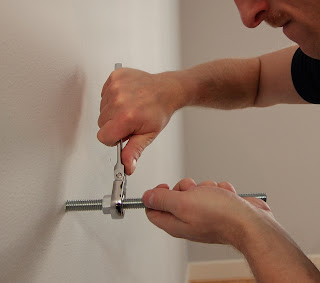
This was the hardest part to conceptualize, and we always had the backup plan of getting corbels and doing a traditional mount. I figured there'd be some ready-made solution somewhere but I couldn't find anything that was a) invisible and b) substantially strong. I went to a hardware store and pored over a catalog to find what I really wanted, which was basically a metal dowel with a screw tip. They actually had them, but after I received them it became quickly apparent they wouldn't be up to the task. The bolt bent under 5-10lbs of weight, and the shelves alone weigh about 20 apiece. I returned the hardware and decided I probably needed to make my own solution from basics I could get at Home Depot. My first attempt was to go with some 1/2"x10" lag bolts, though they had the complication that they have the big hex heads on them and I didn't want to deal with hiding that in the wood anywhere. But, if I cut them off, I have to find another way to drive them into the wall studs. A solution to this is to thread two nuts onto the bolt and use a wrench to turn the one farther from the wall towards the wall. It will then butt up against the other, seizing together and gripping the bolt instead. Unfortunately the lag bolt's unthreaded diameter is too large and those nuts would have to stay, thus forcing me to cut additional diameter into the shelf boards to hide those. Not a huge deal, but annoying. It then occurred to me that I could just use threaded rod instead, be able to remove the nuts AND it has the added benefit that the threads should grab into the shelves a bit and help keep it in place. Some prototyping showed me that 1/2" was the right diameter, anything less would be too flexible under a typical load.
The actual mount:
A lot has to go just right here. For starters, the holes in the board and the wall must line up exactly, and they need to yield a level shelf. To solve this, I cut two 4'x2" strips of plywood (table saw is handy here!) which I then mounted to the wall with screws exactly where the shelf would go, checking that it was level as well. I then used a stud finder to find where the 3 studs in the 4' stretch were. I then drilled 1/8" pilot holes through the plywood, into the drywall, using a drill guide to make sure they were exactly perpendicular. I marked the visible side of each plywood to indicate which shelf they corresponded to. Then I removed them from the wall, placed the marked face of each up against the back of the shelf it belongs to, lined up the corners and attached it with some screws. I then repeated the pilot hole process into the shelf. Without the guide, the holes may not be exactly in the right spots, leading to a shift or tilt in the shelf, or worst case, not all the holes lining up with the wall. Then, I needed help. There's probably some other way to do this alone, but I couldn't come up with an effective way to drill exactly perpendicular with a big speed-bore bit (the guide just shakes around too much to be useful). I used a square to draw lines straight down the face of the board, one lined up with each hole, that I could visually align the bit with. This solved one of the free dimensions, so I had Marisa sit there with the square against the back of the shelf as I drilled with a 1/2" bit, telling me when I was aligned or not. The ideal tool here would be a drill press, but I didn't have one of those. I used a spare threaded rod to make sure the holes were straight and to scrape them out slightly, essentially using the threads like a file. I tried using the guide when drilling into the all with a 7/16", but that didn't work so well. A similar line+sqaure+help process would have been better. Once all the holes were drilled (I went about 5" deep into the studs, the shelves are on an outer wall so they're going into 2x6s; fully into a 2x4 would be perfectly fine as well), it was time to drive the threaded rod into the studs. I did this using the two-nuts trick I mentioned before. Drilling the holes in the stud to be the same size as the core of the threaded rod allows the thread to twist nice and snugly into the wood. Use a hacksaw to cut the rods down to a length that will fit inside the shelf. I had them go most of the way through the shelf (~7 of the 8.5" depth), though I'm not sure that's needed structurally).
The finish:
This was another big unknown when we started. I was fairly certain that a Danish oil finish was the way to go, but we used the leftover foot of board to practice and try techniques on. Step 1 is definitely sanding. I used a powered orbital sander for all the steps. 80 grit got the mill marks and my doodles out of the wood, then 150 smoothed that out, and a final pass with 400 polished everything to a nice glass-like shine. I then found a great trick to clean out all the saw dust and snag any remaining loose splinters, etc: super fine steel wool. It's like $3 for a 12-pack and its texture pulls out and captures all the dust as well as essentially filets off any last loose tidbits. Running it along the edges between faces gives a great tiny-radius softening, just so the edges aren't literally sharp. However, when I applied the Danish oil, we liked the color but were surprised at how much it brought out the stripes (perpendicular to the grain, below right) in the wood. Using the leftovers as the practice was perfect here because it responds exactly like the shelf itself will. We nixed the Danish oil and went with just a buffed paste wax finish (left) instead. We had decided against a urethane-type coat because it's a clearly visible layer instead of just looking like richer wood. The other options provide less protection, but we're not planning on putting anything wet/sticky/etc on the shelves. I repeated the sanding and waxing on the actual shelves, and they came out great! Note: I also used the steel wool to gently smooth down the artfully split edge, which was quite splintery in its original state.

Mounting the shelf:
So now I had a wall full of threaded rods and complementary-drilled, finished shelves. The last step is to simply slide the shelf onto the rods! I knew the rods weren't exactly perpendicular though, so I wasn't expecting an easy step here. Both shelves lined up pretty well, but neither just "slid on". I ended up having to get out a hammer to get the shelves all the way to the wall. To avoid mangling my handiwork, I used a piece of smooth hemlock to cushion the blows from a large hammer. I broke my hemlock cushion into several pieces, but the mission was accomplished: the shelf wiggled on, bit by bit, until it was snugly up against the wall. Great success!

I estimate I put 25-30 hours into this project between concept, finding the right lumber, developing the techniques involved to get it all mounted straight and finished, and then actually applying those steps. Once we figured out that we wanted floating shelves, here's how I did it:
The lumber:
This is the least deterministic piece of the puzzle. We figured out (and mocked up with some plywood) that we wanted shelves that were about 2" thick, about 8-10" deep and 4 feet long, with the slight overlap as you see in the final result. We debated several types of wood as well but then settled between maple (matches the floors) or cherry (matches the table). Anything in the dark wood family was out for color reasons, and other light hardwoods didn't quite fit the bill (poplar is too green-toned, ash and hickory didn't have the right types of grain and typical embellishments). Of course this is all personal taste. We then looked at possible sources. It's easy enough to buy a cherry or maple board, but most of them are milled to something like 1"x10"x6', which is really only 3/4" thick. Your typical lumber store may not have anything thicker. Since I have a table saw and miter saw, it's no big deal to shave the depth down to spec or cut the board to the length we wanted, but the thickness is not something I wanted to mess with. I floated the idea of gluing two boards together, but Marisa vetoed the resulting grain disruption along all the edges where the glue line would go. I agreed too. I then looked to the internet, and found www.thelumbershack.com. They have a huge, searchable, inventory and I found some candidates, but Marisa said she preferred to see it in person so we committed to finding some specialty stores. That weekend we happened to be visiting her parents in Spokane and we took a quick trip to Windsor Plywood. I didn't really have my hopes up (based on their name, primarily), but they turned out to have the best selection I've ever seen (out of the 3 stores I've been to). We found a great, 9'-long cherry board, had the store chop it in half and brought it home. We then cut it to two 4-foot lengths, keeping the interesting features of the boards.

The mounting approach:
This was the hardest part to conceptualize, and we always had the backup plan of getting corbels and doing a traditional mount. I figured there'd be some ready-made solution somewhere but I couldn't find anything that was a) invisible and b) substantially strong. I went to a hardware store and pored over a catalog to find what I really wanted, which was basically a metal dowel with a screw tip. They actually had them, but after I received them it became quickly apparent they wouldn't be up to the task. The bolt bent under 5-10lbs of weight, and the shelves alone weigh about 20 apiece. I returned the hardware and decided I probably needed to make my own solution from basics I could get at Home Depot. My first attempt was to go with some 1/2"x10" lag bolts, though they had the complication that they have the big hex heads on them and I didn't want to deal with hiding that in the wood anywhere. But, if I cut them off, I have to find another way to drive them into the wall studs. A solution to this is to thread two nuts onto the bolt and use a wrench to turn the one farther from the wall towards the wall. It will then butt up against the other, seizing together and gripping the bolt instead. Unfortunately the lag bolt's unthreaded diameter is too large and those nuts would have to stay, thus forcing me to cut additional diameter into the shelf boards to hide those. Not a huge deal, but annoying. It then occurred to me that I could just use threaded rod instead, be able to remove the nuts AND it has the added benefit that the threads should grab into the shelves a bit and help keep it in place. Some prototyping showed me that 1/2" was the right diameter, anything less would be too flexible under a typical load.
The actual mount:
A lot has to go just right here. For starters, the holes in the board and the wall must line up exactly, and they need to yield a level shelf. To solve this, I cut two 4'x2" strips of plywood (table saw is handy here!) which I then mounted to the wall with screws exactly where the shelf would go, checking that it was level as well. I then used a stud finder to find where the 3 studs in the 4' stretch were. I then drilled 1/8" pilot holes through the plywood, into the drywall, using a drill guide to make sure they were exactly perpendicular. I marked the visible side of each plywood to indicate which shelf they corresponded to. Then I removed them from the wall, placed the marked face of each up against the back of the shelf it belongs to, lined up the corners and attached it with some screws. I then repeated the pilot hole process into the shelf. Without the guide, the holes may not be exactly in the right spots, leading to a shift or tilt in the shelf, or worst case, not all the holes lining up with the wall. Then, I needed help. There's probably some other way to do this alone, but I couldn't come up with an effective way to drill exactly perpendicular with a big speed-bore bit (the guide just shakes around too much to be useful). I used a square to draw lines straight down the face of the board, one lined up with each hole, that I could visually align the bit with. This solved one of the free dimensions, so I had Marisa sit there with the square against the back of the shelf as I drilled with a 1/2" bit, telling me when I was aligned or not. The ideal tool here would be a drill press, but I didn't have one of those. I used a spare threaded rod to make sure the holes were straight and to scrape them out slightly, essentially using the threads like a file. I tried using the guide when drilling into the all with a 7/16", but that didn't work so well. A similar line+sqaure+help process would have been better. Once all the holes were drilled (I went about 5" deep into the studs, the shelves are on an outer wall so they're going into 2x6s; fully into a 2x4 would be perfectly fine as well), it was time to drive the threaded rod into the studs. I did this using the two-nuts trick I mentioned before. Drilling the holes in the stud to be the same size as the core of the threaded rod allows the thread to twist nice and snugly into the wood. Use a hacksaw to cut the rods down to a length that will fit inside the shelf. I had them go most of the way through the shelf (~7 of the 8.5" depth), though I'm not sure that's needed structurally).

The finish:
This was another big unknown when we started. I was fairly certain that a Danish oil finish was the way to go, but we used the leftover foot of board to practice and try techniques on. Step 1 is definitely sanding. I used a powered orbital sander for all the steps. 80 grit got the mill marks and my doodles out of the wood, then 150 smoothed that out, and a final pass with 400 polished everything to a nice glass-like shine. I then found a great trick to clean out all the saw dust and snag any remaining loose splinters, etc: super fine steel wool. It's like $3 for a 12-pack and its texture pulls out and captures all the dust as well as essentially filets off any last loose tidbits. Running it along the edges between faces gives a great tiny-radius softening, just so the edges aren't literally sharp. However, when I applied the Danish oil, we liked the color but were surprised at how much it brought out the stripes (perpendicular to the grain, below right) in the wood. Using the leftovers as the practice was perfect here because it responds exactly like the shelf itself will. We nixed the Danish oil and went with just a buffed paste wax finish (left) instead. We had decided against a urethane-type coat because it's a clearly visible layer instead of just looking like richer wood. The other options provide less protection, but we're not planning on putting anything wet/sticky/etc on the shelves. I repeated the sanding and waxing on the actual shelves, and they came out great! Note: I also used the steel wool to gently smooth down the artfully split edge, which was quite splintery in its original state.

Mounting the shelf:
So now I had a wall full of threaded rods and complementary-drilled, finished shelves. The last step is to simply slide the shelf onto the rods! I knew the rods weren't exactly perpendicular though, so I wasn't expecting an easy step here. Both shelves lined up pretty well, but neither just "slid on". I ended up having to get out a hammer to get the shelves all the way to the wall. To avoid mangling my handiwork, I used a piece of smooth hemlock to cushion the blows from a large hammer. I broke my hemlock cushion into several pieces, but the mission was accomplished: the shelf wiggled on, bit by bit, until it was snugly up against the wall. Great success!
Saturday, November 16, 2013
So about that stack rank ...
Microsoft recently announced that they are changing their review model. Several outlets have passed this on and added anecdotes about how "many current and ex employees say the stack rank is the single most destructive process to the company" and that "maybe doing away with the stack rank will finally get Microsoft out of its lost decade".
Let's start with the basics. Microsoft has had over 500,000 employees, past and present. It's trivial to find a handful of them to align with any viewpoint. In other words, any speculation about the effects of the stack rank are easy to 'support'. I haven't looked hard, but I've yet to hear about a counterpoint (though stories about 'company does things right' tend not make anyone's must-read list).
Now another basic: the new policies say nothing about getting rid of the stack ranking, they just remove the forced curve. These are separate things. Without a stack rank, there's no ability to create differentiated compensation. Take it for what it's worth, but when I worked at IBM the lack of differentiated compensation was the single most destructive aspect of the job. The good people get fed up and leave for greener pastures, or get sick of trying harder when there's no motivation and become burnouts.
There's a slightly annoying conflation of "stack rank" with "forced curve", and somehow we decided that both of these are terrible things, cause in-fighting and back stabbing, and take up everyone's mental faculties with trying to get ahead. Lost in this is that this only really applies if within the small group I work with, my success can only come at the cost of someone else's failure. In reality, the populations that the ranks are done over are big enough that we can both succeed more by helping each other. I'd never even talk to the guys we're both trying to surpass, therefore I have no ability to sabotage them.
Evaluation is a totally standard part of all perf-based endeavors. For example, we get grades in school. We are evaluated, given a rating. Those ratings more-or-less conform to an ordering of students, or a stack rank, if you will. Sure, there can be some ties here and there, but whatever. The better the evaluation, the better the reward. The big difference between school and work is that school doesn't have a fixed budget: the teacher can give everyone an A if they want. At work, there's a fixed budget. If I give someone an A, someone else has to get an F. Or 2 people get Ds. Etc. This would be the forced curve, which some teachers employ...and even in those classes, students study together instead of trying to undermine each other.
The interesting aspect of a forced curve is that it eliminates the ability for a manager to inflate reviews on an absolute scale (or go easy on their low performers) because they know their own people. Furthermore, how can we have any semblance of consistency across a company of 90,000 people. The forced curve combined with a stack rank is an external function that at least in some ways aligns evaluations across the whole company. It can also apply a large-scale statistical model over the company that sheds light on what percent of the workforce is doing at least a satisfactory job and what percent could likely be replaced by a new hire. In the soon-to-be-past system, my review would indicate clearly roughly what percent of people with my same title were better than me. And, that's valuable. Most of us do a fine job, and the best way to know we can improve is to know that, in fact, some non-trivial percent of people were deemed better.
People worry about the degenerate cases of the entirely all-star team or the entirely bad team where people get artificially low or high reviews. These are theoretically possible, and certainly some people end up on the wrong side of a curve boundary. However, in practice these degenerate scenarios don't exist and the monetary impact of being on one side or the other of a review boundary isn't monumental. Without getting into the details, the differentiation is big enough to be worth working for, but not so big that it's life-changing.
Without tangible incentives, workers will learn what their minimum passable effort is.
I believe that differentiation compensation is a must.
To assign differentiated compensation, there must be an ordering of employee performances that is in correspondence with the assigned rewards.
Let's start with the basics. Microsoft has had over 500,000 employees, past and present. It's trivial to find a handful of them to align with any viewpoint. In other words, any speculation about the effects of the stack rank are easy to 'support'. I haven't looked hard, but I've yet to hear about a counterpoint (though stories about 'company does things right' tend not make anyone's must-read list).
Now another basic: the new policies say nothing about getting rid of the stack ranking, they just remove the forced curve. These are separate things. Without a stack rank, there's no ability to create differentiated compensation. Take it for what it's worth, but when I worked at IBM the lack of differentiated compensation was the single most destructive aspect of the job. The good people get fed up and leave for greener pastures, or get sick of trying harder when there's no motivation and become burnouts.
There's a slightly annoying conflation of "stack rank" with "forced curve", and somehow we decided that both of these are terrible things, cause in-fighting and back stabbing, and take up everyone's mental faculties with trying to get ahead. Lost in this is that this only really applies if within the small group I work with, my success can only come at the cost of someone else's failure. In reality, the populations that the ranks are done over are big enough that we can both succeed more by helping each other. I'd never even talk to the guys we're both trying to surpass, therefore I have no ability to sabotage them.
Evaluation is a totally standard part of all perf-based endeavors. For example, we get grades in school. We are evaluated, given a rating. Those ratings more-or-less conform to an ordering of students, or a stack rank, if you will. Sure, there can be some ties here and there, but whatever. The better the evaluation, the better the reward. The big difference between school and work is that school doesn't have a fixed budget: the teacher can give everyone an A if they want. At work, there's a fixed budget. If I give someone an A, someone else has to get an F. Or 2 people get Ds. Etc. This would be the forced curve, which some teachers employ...and even in those classes, students study together instead of trying to undermine each other.
The interesting aspect of a forced curve is that it eliminates the ability for a manager to inflate reviews on an absolute scale (or go easy on their low performers) because they know their own people. Furthermore, how can we have any semblance of consistency across a company of 90,000 people. The forced curve combined with a stack rank is an external function that at least in some ways aligns evaluations across the whole company. It can also apply a large-scale statistical model over the company that sheds light on what percent of the workforce is doing at least a satisfactory job and what percent could likely be replaced by a new hire. In the soon-to-be-past system, my review would indicate clearly roughly what percent of people with my same title were better than me. And, that's valuable. Most of us do a fine job, and the best way to know we can improve is to know that, in fact, some non-trivial percent of people were deemed better.
People worry about the degenerate cases of the entirely all-star team or the entirely bad team where people get artificially low or high reviews. These are theoretically possible, and certainly some people end up on the wrong side of a curve boundary. However, in practice these degenerate scenarios don't exist and the monetary impact of being on one side or the other of a review boundary isn't monumental. Without getting into the details, the differentiation is big enough to be worth working for, but not so big that it's life-changing.
Without tangible incentives, workers will learn what their minimum passable effort is.
I believe that differentiation compensation is a must.
To assign differentiated compensation, there must be an ordering of employee performances that is in correspondence with the assigned rewards.
Tuesday, October 29, 2013
LinkedIn's Dilemma
I wrote a while back about Facebook's dilemma: that while they're sitting on a treasure trove of personal information, exploiting that information will likely alienate their user base because Facebook is supposed to be a somewhat safe place, a sandbox of sorts.
LinkedIn is in a similar pickle since going public. They're sporting a nearly 1000 P/E ratio which is propping up a market cap of 27B. In contrast, Facebook's is a mere quarter of that, suggesting that if LinkedIn can't do something drastic, they stand to lose about 20B of company value. Ouch. Clearly there is pressure for them to monetize, but they need to be very careful about how they do it. They recently announced a service called Intro that would re-route users' emails through LinkedIn's email servers and append the sender's LinkedIn profile data to all mails. They note that this will allow people to connect more with others, perhaps even adding those people on LinkedIn.
I don't know that this is valuable though, or at least not to anyone other than recruiters. LinkedIn should instead consider acquiring services like Angie's List and aggregating various reviews to create a sort of uber profile. Make a person like me want to have LinkedIn, because through it I can really assess the professional qualifications of someone I interact with. Appending profile data to every email is simply overkill because most people I send most emails to are my family and coworkers who I already know plenty well. Most mail I receive is corporate ad mail. For every one of these cases, additional profile data is just in the way. I also need to now worry that if I send someone something sensitive, it may go through LinkedIn's servers as well. Imagine if I send my mom an email that I'm thinking about looking around for other jobs ... now maybe I get promoted to recruiters suddenly as a higher-value target? And suddenly I start getting calls? I'm not sure I like that.
Finally, a note on the irony of LinkedIn's social graph. Promoting more connections actually weakens the information LinkedIn provides. Connections are supposed to be a sort of partial endorsement. If everyone endorses everyone, we get no new information. Same goes for skills endorsements: everyone has seen plenty of cases where someone with no understanding of a field endorses their friend in that field.
Instead of working on spamming and ad features, LinkedIn needs to work on relevancy. The end.
LinkedIn is in a similar pickle since going public. They're sporting a nearly 1000 P/E ratio which is propping up a market cap of 27B. In contrast, Facebook's is a mere quarter of that, suggesting that if LinkedIn can't do something drastic, they stand to lose about 20B of company value. Ouch. Clearly there is pressure for them to monetize, but they need to be very careful about how they do it. They recently announced a service called Intro that would re-route users' emails through LinkedIn's email servers and append the sender's LinkedIn profile data to all mails. They note that this will allow people to connect more with others, perhaps even adding those people on LinkedIn.
I don't know that this is valuable though, or at least not to anyone other than recruiters. LinkedIn should instead consider acquiring services like Angie's List and aggregating various reviews to create a sort of uber profile. Make a person like me want to have LinkedIn, because through it I can really assess the professional qualifications of someone I interact with. Appending profile data to every email is simply overkill because most people I send most emails to are my family and coworkers who I already know plenty well. Most mail I receive is corporate ad mail. For every one of these cases, additional profile data is just in the way. I also need to now worry that if I send someone something sensitive, it may go through LinkedIn's servers as well. Imagine if I send my mom an email that I'm thinking about looking around for other jobs ... now maybe I get promoted to recruiters suddenly as a higher-value target? And suddenly I start getting calls? I'm not sure I like that.
Finally, a note on the irony of LinkedIn's social graph. Promoting more connections actually weakens the information LinkedIn provides. Connections are supposed to be a sort of partial endorsement. If everyone endorses everyone, we get no new information. Same goes for skills endorsements: everyone has seen plenty of cases where someone with no understanding of a field endorses their friend in that field.
Instead of working on spamming and ad features, LinkedIn needs to work on relevancy. The end.
Subscribe to:
Posts (Atom)